


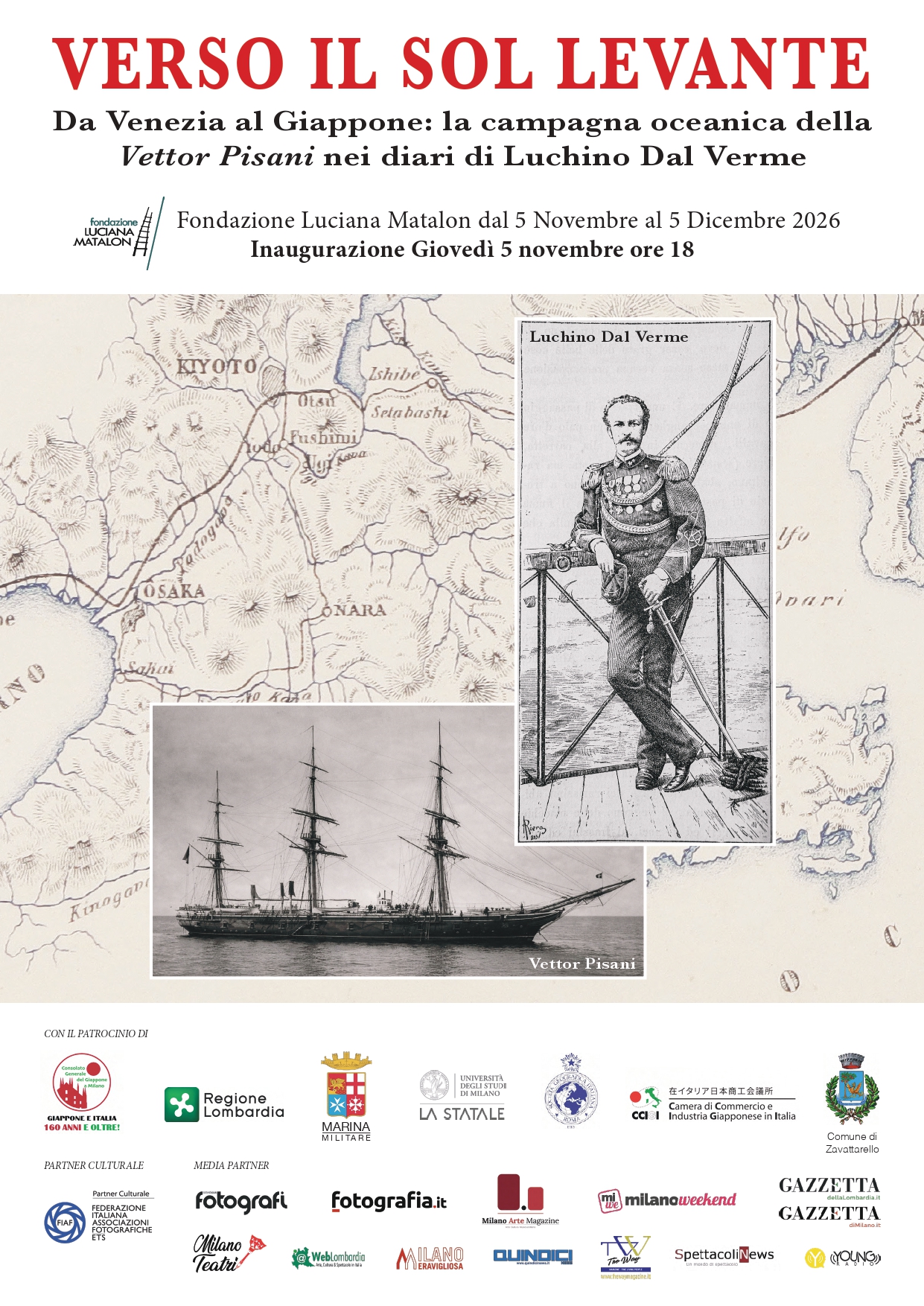
TOWARDS THE RISING SUN
From Venice to Japan: the Vettor Pisani ocean expedition as recorded in Luchino dal Verme’s diaries
6 November to 5 December 2026
Luciana Matalon Foundation
Free admission
Opening: Thursday 5 November, 6.00 pm (by invitation only)
The opening will be accompanied by a staged reading of excerpts from Giappone e Siberia by Luchino dal Verme, performed by the actor Riccardo Mazzarella, with a backdrop of folk songs and ceremonial music from the period
To mark the 160th anniversary of diplomatic relations between Italy and Japan, the Luciana Matalon Foundation presents *Towards the Rising Sun*. From Venice to Japan: the Vettor Pisani’s oceanic voyage as recorded in the diaries of Luchino Dal Verme, an exhibition that brings to life an extraordinary journey undertaken at a time when a unified Italy was still taking its first steps on the international stage and Japan, under the rule of Emperor Meiji, was opening up to modernity with surprising speed.
The exhibition project, conceived and curated by Nello Taietti, has been organised under the patronage of the Italian Navy, the Consulate-General of Japan in Milan, the Lombardy Region, the Municipality of Zavattarello, the University of Milan, the Italian Geographical Society and the Japanese Chamber of Commerce in Italy.
At the heart of the project is the figure of Luchino Dal Verme (1838–1911), a General Staff officer, man of letters and tutor to Prince Tommaso of Savoy, Duke of Genoa, who took part in the long voyage of the Royal Corvette Vettor Pisani as a keen observer and perceptive interpreter of a world then far removed from Europe.
Her journey, which began on 31 March 1879 when the Vettor Pisani set sail from Venice, now forms the central thread of a narrative that spans seas, continents and civilisations. Above all, however, it bears witness to the encounter between the young Kingdom of Italy and a Japan caught between the strength of its own traditions and the momentum of the transformation ushered in by the Meiji era.
A journey through time and space
The Vettor Pisani’s route stretched across the Mediterranean, the Red Sea and the Indian Ocean, all the way to the coasts of the Far East. Nagasaki, Yokohama and Kobe were just some of the ports of call on a voyage that was not merely military and diplomatic, but also human, cultural and exploratory.
On board the corvette, Dal Verme observes, takes notes and questions the reality he encounters. His gaze captures landscapes, customs, architecture, works of art, rituals and people, conveying the sense of wonder and, at times, disorientation that accompanies every genuine encounter with otherness.
Among the most significant episodes of the mission was the encounter on 7 January 1881, when Emperor Meiji Mutsuhito personally boarded the Vettor Pisani in Yokohama to attend the official luncheon in honour of the Duke of Genoa. A moment of great symbolic significance, in which the personal stories of the protagonists intertwine with the broader history of relations between two countries destined, over time, to forge an ever-deeper dialogue.
The voice of Luchino dal Verme
At the heart of the exhibition is Japan and Siberia, the volume published by Luchino dal Verme in 1882 following the conclusion of the expedition and the subsequent return journey through Siberia.
The book is much more than a travel journal. It bears witness to a curious and engaged perspective, capable of combining the precision of the observer with the sensitivity of a man of letters. Within its pages, descriptions of places are accompanied by reflections on the societies encountered, their artistic forms, customs, daily life and the profound changes that Asia was undergoing.
It is precisely this voice – both personal and historical – that forms the ideal centrepiece of the exhibition and which, almost a century and a half later, continues to challenge the present day on the meaning of travel, knowledge and the encounter between cultures – an aspect that remains as relevant as ever today.
Traces of a journey
The exhibition stems from a desire to bring to light not only the grand historical scale of the expedition, but also its intimate, everyday dimension as experienced by those who lived through the journey, observed it and preserved its traces. The exhibition thus forges a dialogue between previously unpublished documents, letters, diaries, handwritten notes and ducal correspondence, gradually revealing the human side of Luchino dal Verme and the complexity of his experience.
These testimonies are complemented by 25 rare original photographs from the Meiji era, drawn from the archive of Nello Taietti, alongside some 80 photographs relating to the journey, kindly provided by the Dal Verme family’s photographic archive. These images are not mere illustrations, but genuine gateways through which the viewer can gain an insight into a Japan now long gone, captured at the most delicate moment of its transformation.
The narrative is complemented by hydrographic surveys, maps and historical cartographic materials, which accompany the story and broaden the perspective on the cultural heritage encountered by the Italian mission.
The result is an exhibition conceived as a journey through memory, but also as a reflection on the value of knowledge, for every journey leaves behind not only a geography of places, but also an inner geography made up of encounters, images, reflections and transformations.
From memory to relationship
160 years on from the establishment of diplomatic relations between Italy and Japan, *Verso il Sol Levante* returns to that original moment when the two countries began to regard one another with mutual curiosity, to rediscover how the history of international relations is, first and foremost, made up of people, ideas and individual experiences.
This is why the Vettor Pisani served as the symbolic setting from which a dialogue took shape. Luchino dal Verme bore witness to this, through writing that is still capable today of conveying the wonder of distant lands and, at the same time, of showing us how every encounter with another culture ultimately alters our personal relationship with the rest of the world and the way in which we view ourselves.
From this perspective, the new exhibition organised by the Luciana Matalon Foundation does not merely recount a journey undertaken in 1879, but marks the moment when a geographical distance began to transform into a relationship, and an oceanic voyage into a shared history.
Side events
The exhibition programme will be accompanied by a series of cultural events designed to explore the themes of the exhibition and the encounter between Italian and Japanese culture:
- Thursday 5 November 2026, 6.00 pm — Opening ceremony with a staged reading
Presentation of the exhibition, enhanced by a reading of excerpts from *Japan and Siberia*, performed by the actor Riccardo Mazzarella and accompanied by folk and ceremonial music of the period.
- Saturday 14 November 2026, 4.00 pm — Chamber music concert
Organised by Notturno Musica, a musical journey inspired by the Eastern influences that shaped European culture between the 19th and 20th centuries.
(Admission fee applies; booking required: [email protected])
- Thursday 19 November 2026, 6.00 pm — Book launch: Japan. Sketches from the Floating World
A discussion with the author Stefano Faravelli and Alberto Moro to reflect, through drawings and travel writing, on the contemporary dialogue with Japanese art.
(Free admission, subject to availability)
info & contacts:
Fondazione Luciana Matalon
+39 02 878781
[email protected]
www.fondazionematalon.org
Opening hours
Tuesday to Saturday
10:00 – 13:00 | 14:00 – 19:00
Free admission
Exhibition press office
De Angelis Press, Milano
345 7190941 | [email protected]