


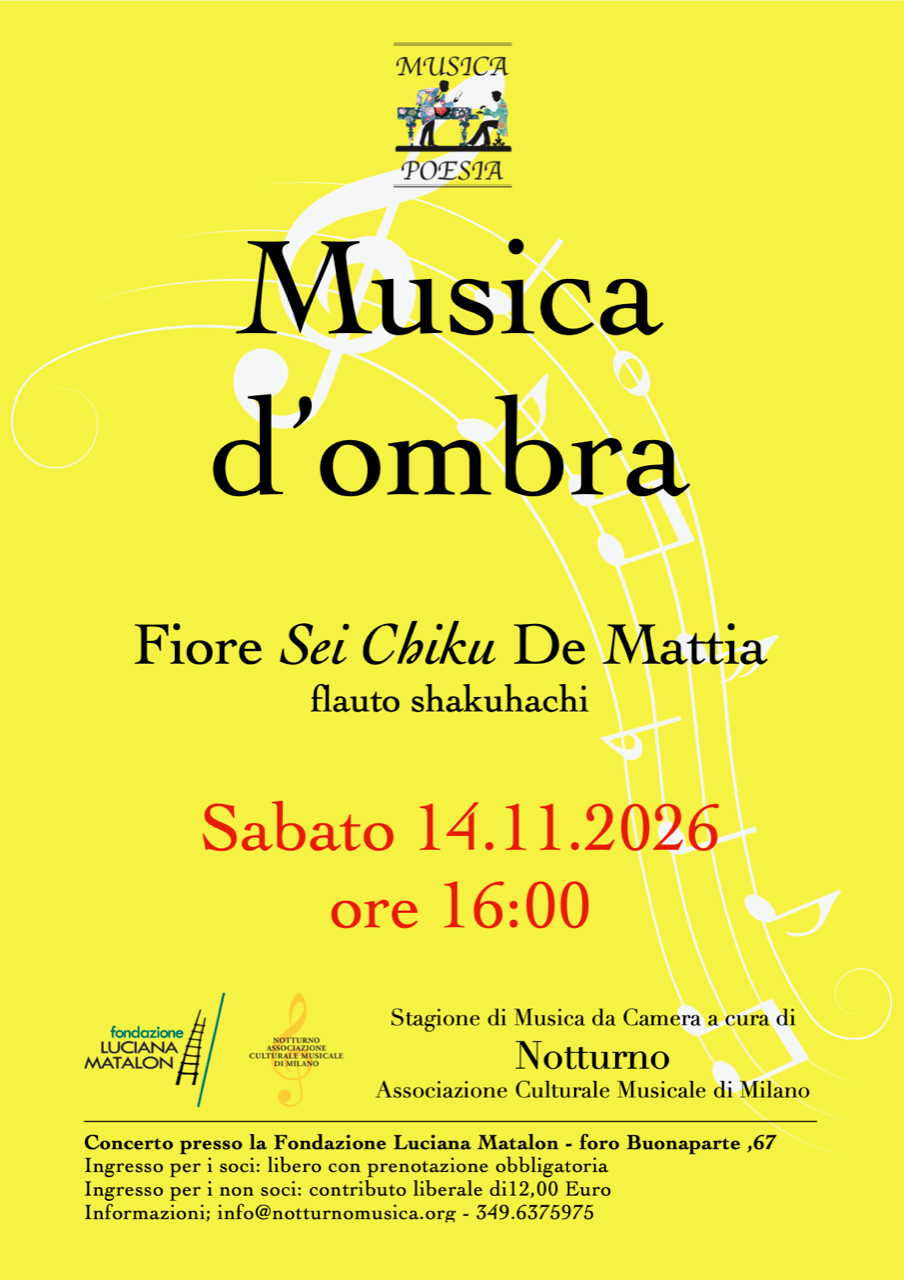
To mark the exhibition on Luchino Dal Verme’s journey to Japan in the late 19th century, MusicaPoesia is hosting, for the first time, a concert entirely dedicated to music for the shakuhachi flute – a bamboo instrument with an ancient tradition in Japanese culture and, alongside the koto and the shamisen, a central feature of the music of the Edo period (1603–1867). Originating in the Zen Buddhist tradition as an instrument to aid in achieving a particular state of meditation or to practise deep breath control, it later became widespread in secular contexts too, both as a solo instrument and in ensembles with other instruments. To this day, the shakuhachi remains at the heart of traditional practice but has also attracted the attention of contemporary composers who have sought to blend Japanese instruments with Western elements.
The Programme
Music of Shadows
The programme features pieces for the shakuhachi flute drawn from the original sacred meditative repertoire, performed in the style of the ‘Hijiri’ school (sacred/holy school) based in Tokyo, founded and directed by Master Teruhisa Fukuda. Following a long period spent in China, the Japanese monk Kakushin (1207–1298) is regarded as the first to have introduced Zen music for the shakuhachi flute to Japan. It was he who gave rise to the tradition of itinerant mendicant monks, known as komusô, belonging to the particular fuke branch of Zen Buddhism, for whom the shakuhachi was the only possession they held. The importance of the instrument to the Fuke sect is reflected in maxims such as ‘There is prayer in sound’ or ‘The breath of the flute is the Way to enlightenment’. From this tradition emerged Kurosawa Kinko (1710–1771), a Fuke monk who collected and passed on the remarkable repertoire for the shakuhachi that had developed over the centuries. At the heart of this repertoire lie the thirty-six pieces linked to the Zen tradition, written exclusively for solo shakuhachi and known as honkyoku; each is attributed to the founder of a particular school of the instrument. Honkyoku are characterised by an extremely slow tempo, a highly expanded use of rhythmic parameters but, above all, by the soloist’s skilful, focused and restrained use of the instrument’s infinite sonic and expressive possibilities, through which they re-create the traditional pieces with every performance. It should be noted that honkyoku were not, at least initially, pieces conceived to be appreciated by a wide audience, but rather to help the player attain a particular state of meditation or to practise deep breath control – a concept that is both organological and musical in nature – as expressed in the Zen saying: ‘The shakuhachi plays Te, just as much as you play it’…”
Biography
Fiore Sei Chiku De Mattia is the official representative in Italy and Europe of the Hijiri School of the Japanese shakuhachi flute, for which he was awarded the title of ‘Dai Shihan’ (Grand Master) in 2023. A member since 2003 of the French association “La Voie Du Bambou”, whose aim is to teach and promote knowledge of the Japanese bamboo flute, the shakuhachi, he subsequently furthered his studies under the guidance of Master Teruhisa Fukuda, founder of the “Hijiri” (sacred) school in Tokyo, receiving the official name “Sei Chiku” (holy/sacred bamboo). For over twenty years, he has been dedicated to promoting the shakuhachi in Italy through his concert performances and teaching activities.
Free entry for members
Entry for non-members: €12.00
Booking required
Enquiries: 349 637 5975